

Last updated: January 2026
Time to Read:
Australia’s aged care sector is growing fast—and demand for service/associated providers is growing even faster.
If you’re a healthcare professional or you run a home services business, aged care can become one of the most reliable sources of recurring work you’ll find in 2026.
This guide is for healthcare professionals and home service businesses who want consistent aged care work in 2026.
The challenge is simple. Most people don’t know where to start. This guide gives you a clear path.
Fast Track Setup (save this)
To start getting aged care work in 1–2 weeks, you’ll usually need:
✅ Australian Business Number (if you’re contracting)
✅ National Police Check (commonly valid for 3 years)
✅ Insurance (public liability or professional indemnity)
✅ Licences or registrations (if relevant)
✅ A simple way to track jobs, notes, and invoices (even a spreadsheet is fine)Once you have these ready, onboarding with registered/approved providers becomes much faster.
Why Aged Care Work Is Worth It
Aged care work has a different “feel” from private client work—in a good way.
Most service/associated providers stick with it because it tends to offer:
- Steady job flow with less seasonality
- More reliable payments through registered/approved providers
- Recurring jobs (weekly cleaning, fortnightly gardening, regular clinical visits)
- Less lead chasing once you’re in the system
If you’ve been dealing with one-off jobs, slow-paying customers, or unpredictable schedules, aged care can be a stabiliser for your income.
What Counts as Aged Care Work?
Aged care work isn’t just about residential nursing homes.
Under home-based care models (including Support at Home), aged care work includes any service that helps an older person live safely and independently at home.
If your service helps an older person stay safe, supported, and independent at home, it likely fits.
There are two big buckets:
- Healthcare and clinical services
- Home and lifestyle support services
Both are in demand.
Healthcare and Clinical Services

Registered/approved providers rely on qualified healthcare professionals for services like:
Nursing
- Wound care and dressing changes
- Medication support and administration
- Health monitoring (e.g., blood pressure and vital signs)
- Chronic disease support
- Post-hospital discharge support
Allied Health
- Physiotherapy (mobility, strength, falls prevention)
- Occupational therapy (home assessments, daily living support)
- Speech pathology (swallowing and communication support)
- Podiatry (foot care, diabetic foot management)
- Dietetics (nutrition assessment and meal planning)
Personal Care Support (depending on role and scope)
- Assistance with showering, dressing, and grooming
- Mobility support and transfers
- Continence support
Support Coordination (often suited to experienced professionals)
- Care planning and coordination
- Client navigation and advocacy
- Coordinating multiple providers across services
Home and Lifestyle Support Services

This is where many businesses don’t realise they qualify. But they do.
Home-based aged care relies on practical services that keep a person safe, clean, mobile, and independent.
Cleaning and Domestic Support
- Regular cleaning (vacuuming, mopping, dusting)
- Laundry and linen changes
- Kitchen and bathroom cleaning
Gardening and Lawn
- Mowing and edging
- Weeding and general upkeep
- Pruning and hedge trimming
Home Repairs and Maintenance
- Minor repairs (door handles, taps, light fittings)
- Painting and touch-ups
- Handyperson work and preventative maintenance
Transport and Errands
- Medical appointments
- Shopping support
- Community access and social outings
- Pharmacy pickups
Safety Modifications
- Handrails, ramps, grab bars
- Accessibility improvements
Rule of thumb: If your service helps an older person stay safe at home, it can be aged care work.
Why Demand Is Increasing in 2026
Demand isn’t rising because of just one specific factor. It’s several shifts happening at once:
Australia’s population is aging, and more people need services that support independence at home.
Support at Home is rolling out progressively from July 2025—in practice, this means:
- More services are delivered at home
- Support that starts earlier (before needs become critical)
- Care plans that can change over time (which creates new jobs as needs shift)
The system is designed to keep people at home longer, which increases demand for:
- Home-based clinical services
- Services that reduce fall risk and maintain independence
- Practical home services that prevent escalation
With higher compliance pressure, registered/approved providers often partner with external service providers to:
- Scale capacity up and down
- Access specialised skills
- Reduce workforce administration
What this means for you: More contractor opportunities and more emphasis on being verified and reliable.
How Payment Works (and Why It’s Different from Private Clients)
Aged care payment usually flows like this:
- Older Australians receive government-approved funding
- Registered/approved providers manage care delivery
- Service/associated providers deliver services on behalf of registered/approved providers
- Payment comes from the registered provider, not the individual client
Key point: You’re usually paid by an organisation with a process, not an individual client who might delay invoices. You’ll invoice one organisation instead of chasing multiple individual clients.
Why Service/Associated Providers Like This Setup
Once you’re in the system, many providers find it simpler than juggling private clients:
- More consistent demand year-round
- More predictable payments (many pay within around 14 days)
- Repeat work that builds routine income
- Less marketing once you have a good track record
What You Need to Get Started
You don’t need to overcomplicate this. Most providers can get ready in 1–2 weeks.
For All Service/Associated Providers
- Australian Business Number (for contractors)
- National Police Check
- Insurance (at least public liability for home services)
- Basic documentation system (jobs, invoices, compliance docs)
Additional Requirements for Healthcare Professionals
- Current professional registration (e.g., AHPRA)
- Professional indemnity insurance
- Current CPR and First Aid
- Relevant certifications for your scope (e.g., infection control, manual handling, specialty training
Additional Requirements for Home Service Providers
- Relevant trade licences (where applicable)
- A simple tracking system for:
- Job completion
- Service notes
- Invoices
The Fastest Way to Start Getting Opportunities
There are three common pathways:
1) Direct Clients
You work directly with older people or families.
Pros: Full control over pricing and relationships
Cons: Marketing, quoting, invoicing, and inconsistent volume
2) Partnering Directly with Registered/Approved Providers
You contract with registered aged care organisations.
Pros: More consistent volume
Cons: Repeated onboarding, paperwork, and manual coordination
3) Matching Platforms
Platforms connect verified service/associated providers with registered/approved providers who need services delivered.
Pros: One-time verification, less admin, opportunities routed to you
Cons: You need to keep your availability updated
If you want the fastest start with the least admin, matching platforms are usually the easiest path.
Fill’d helps you get verified once, then routes relevant opportunities to you based on your services, location, and availability.
Ready to Explore Opportunities?
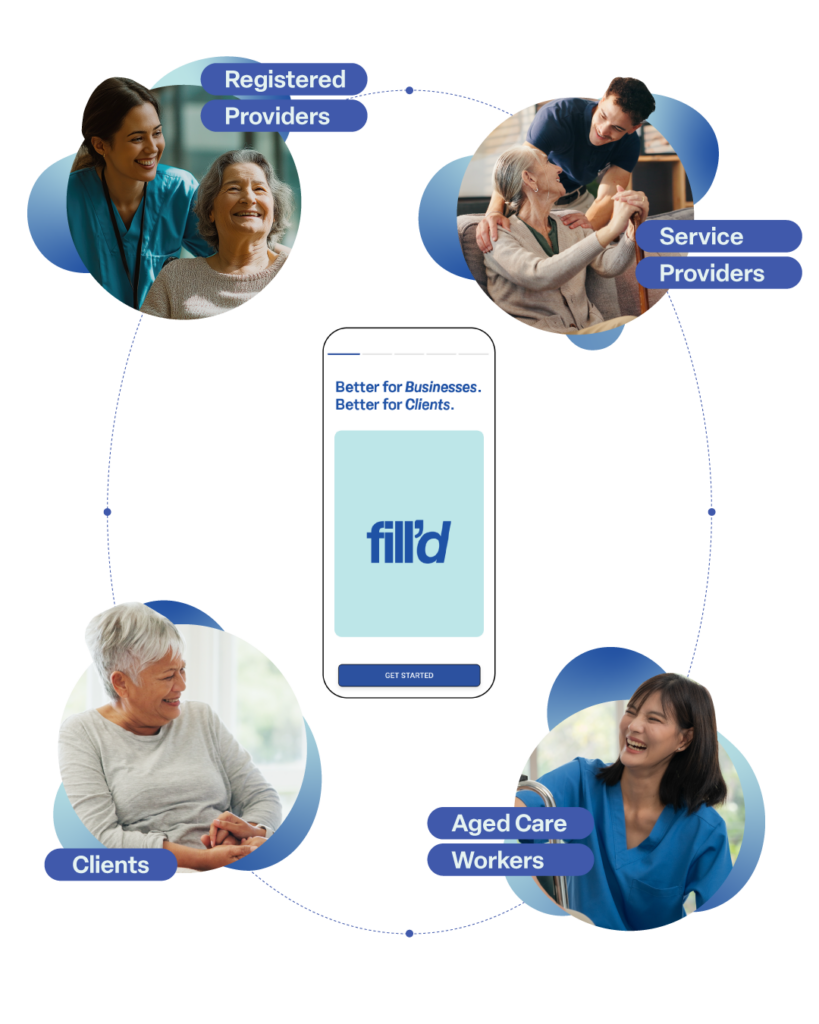
Fill’d connects verified service/associated providers with registered/approved providers needing services delivered.
Frequently Asked Questions
Most service/associated providers start by preparing the core compliance documents (Australian Business Number, National Police Check, insurance, and relevant licences). Then they access work through a registered aged care provider or a matching platform that connects verified providers to service requests.
Aged care work under Support at Home includes clinical services (nursing, allied health, personal care, support coordination) and home services (cleaning, gardening, maintenance, transport, errands, and safety modifications) that help older Australians live safely at home.
No. Many service/associated providers work as contractors or partners to a registered aged care provider. Full registration is usually only required for organisations that manage care plans and funding directly.
Service/associated providers are usually paid by the registered aged care provider that manages the client’s government-funded care plan. Payment is not typically collected directly from the older person receiving care.
Most providers need:
- Australian Business Number (if contracting)
- National Police Check
- Insurance (public liability or professional indemnity)
Healthcare professionals also need AHPRA registration and professional indemnity insurance.
If your documents are ready, onboarding can be quick. If you need to apply for a National Police Check and organise insurance, most providers can be ready within 1–2 weeks.
Yes. Many sole traders and small businesses deliver aged care services as contractors to a registered aged care provider. The key is being verified, reliable, and ready to meet basic compliance requirements.
Not always. Healthcare professionals need professional qualifications, but not necessarily experience in aged care. Home service/associated providers typically do not require experience in aged care. Reliability, communication, and quality matter most.
Many providers find matching platforms easiest because they centralise verification and connect you to relevant opportunities without cold outreach or repeated paperwork.
Related Resources
This blog post was created for informational purposes only. Service/associated providers should verify current requirements with relevant authorities.
Got questions?
Feel free to reach out.
Leave a Reply